
Topic · Season 1 · The Founder's Cognitive Operating System
Mental Models
The frameworks behind exceptional thinking
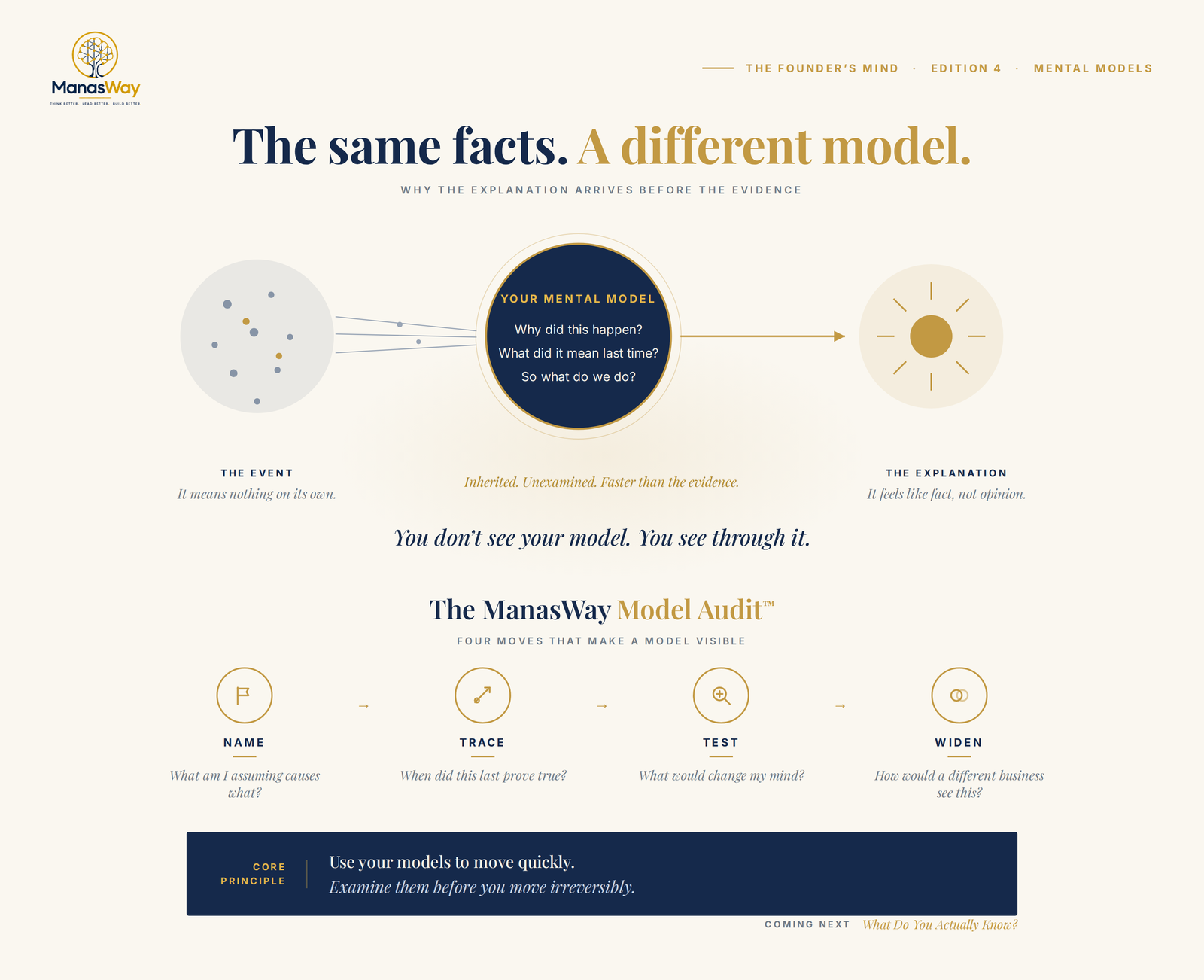
A mental model is a simplified picture of how something works. The models you hold decide what you see, predict and decide, and most of them were absorbed, not chosen.
The idea in brief
Your mind explains before it analyses
-
Models are absorbed, not chosen
They come from a first job, a mentor, one early success, one failure, or an industry that quietly taught you what normal looks like. They run whether or not you know they are there.
-
A good answer can block a better one
Strong chess players said they were searching for a better move. Their eye movements showed they kept looking at the squares tied to the first idea they had.
-
Every company runs on a theory it stopped questioning
Peter Drucker's point: most organisations in trouble are not badly run. They are running correctly on assumptions that stopped being true.
The edition

Edition 4 · 15 October 2026 · 11 min read
What Do You Believe?
And how much of your thinking is actually yours? The explanation arrives whole, from a model you never chose.
The framework
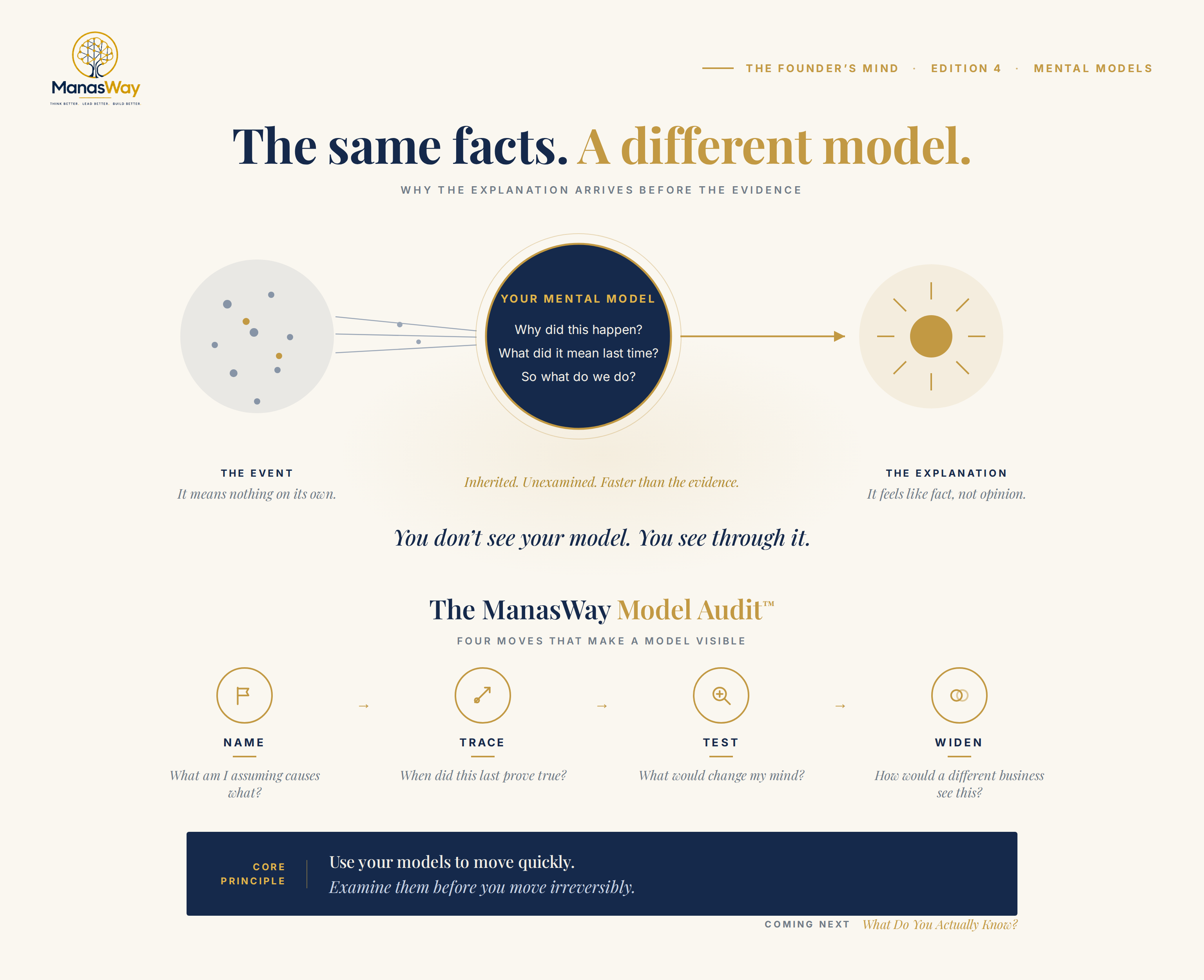
The ManasWay Model Audit™
Name
What am I assuming causes what?
Trace
When did this last prove true?
Test
What would change my mind?
Widen
How would a different business see this?
Try this week
Write down what has to be true
Once a quarter, write on one page what your company's success depends on being true, and date it. Compare it with last quarter's. The drift is the insight.
The Founder's Pause
What did I decide this meant before I had the facts?
Which explanation came out whole, without effort?
Which of my beliefs about this business have I never once tested, because they have always worked?
Go deeper
The sources behind this edition
-
Kenneth Craik, The Nature of Explanation (1943)
The origin of the idea that the mind runs small-scale models of reality.
-
Dedre Gentner, Structure-Mapping: A Theoretical Framework for Analogy (1983) ↗
How a model transfers from one domain to another.
-
Bilalić, McLeod and Gobet, Why good thoughts block better ones, Cognition (2008) ↗
The chess study, including the eye-tracking evidence.
-
Peter Drucker, The Theory of the Business, Harvard Business Review (1994) ↗
Why organisations in trouble are often running on an expired theory.
-
Andrew S. Grove, Only the Paranoid Survive (1996)
The Intel memory decision and the new-CEO question.
-
Charlie Munger, A Lesson on Elementary, Worldly Wisdom (1994)
The latticework of mental models.