Edition 2 · Attention · The Founder's Mind
Where Does Your Instinct Come From?
How experience becomes instinct — and when instinct becomes a trap
By Mohanram PV · 14 August 2026 · 9 min read
There are moments when you simply know. You meet someone. You hear a proposal. You walk into a meeting. You look at a business decision. Nothing obvious appears to be wrong. And yet, something inside you says: something doesn't feel right.
You may not be able to explain it. You may not have enough information to defend it. But you have a feeling. We call it instinct. And because it often arrives before conscious reasoning, we tend to give it a special status: trust your gut.
But perhaps there is a more interesting question. Where did your instinct come from?
Perhaps your mind learned it before you knew you were learning it
Think about something you can now do without much conscious effort. Drive a familiar route. Type on a keyboard. Read someone's hesitation. Handle a difficult conversation. Recognise when a negotiation is beginning to shift.
The first time, you probably had to think. Then you repeated it. You made mistakes. You adjusted. You tried again. Over time, something changed. The response became faster. The movement became smoother. The decision required less conscious effort. What you once had to deliberately think through became something you could increasingly do.
This is one of the remarkable things about procedural learning. Through repetition and practice, skills can become increasingly automatic. And that is incredibly useful — especially for a founder. Years of experience can allow you to notice something before someone with less experience even knows what to look for. You don't consciously calculate everything. You have learned. And eventually, what you have learned can feel like instinct.
But here is where it gets interesting. Not everything the mind learns is wisdom. Some of it is simply pattern. A pattern can become a skill. A pattern can become a habit. A pattern can become a shortcut. And a pattern can remain long after the circumstances that created it have changed.
This is where experience can become both a strength and a trap.
What if your greatest strength has a history?
Imagine someone who has become exceptionally independent. They make decisions quickly. They rarely ask for help. They take responsibility. Everyone around them sees strength. But perhaps somewhere in their history, depending on others didn't work. So they learned: I have to handle it myself. That lesson worked. Perhaps it worked extremely well. It became part of who they were.
Now imagine someone who is extraordinarily cautious. They anticipate problems. They notice risks others miss. They rarely make the same mistake twice. Again, a strength. But perhaps an earlier failure taught them that uncertainty is dangerous. So the mind learned to look for danger before it looked for possibility.
Or consider the founder who needs to control every detail. The leader who struggles to delegate. The negotiator who never trusts easily. The person who reads every silence as a warning. These behaviours may be highly effective in some environments. They may even have protected us at some point.
Which leads to a question worth sitting with: could one of our greatest strengths have started as a defence against something that happened years ago?
The mind remembers what worked. But the world changes.
This may be one of the difficult things about experience. Experience gives us patterns. Patterns help us respond quickly. But familiarity can also create an illusion: I've seen this before.
Maybe you have. But is it really the same? The company has changed. The market has changed. Your role has changed. You have changed. But the response may still be there. Waiting. Ready. Automatic.
And sometimes the very thing that once helped us navigate uncertainty can prevent us from seeing the situation that is actually in front of us. This is where instinct needs awareness. Not rejection. Not blind trust. Awareness.
A good instinct can compress years of experience into a moment. But an old pattern can also compress years of experience into the wrong moment. The challenge isn't to eliminate instinct. The challenge is to understand it.
Bruce Lee and the freedom inside mastery
Bruce Lee's philosophy of mastery offers an interesting lens here. Practice was not simply about accumulating techniques until they became automatic. There was something deeper: freedom within mastery.
The more deeply something is practised, the less conscious effort it may require. But mastery should not imprison you inside the technique. It should give you greater freedom to respond to what is actually happening.
That distinction matters. Because the highest form of practice may not be “I can do this automatically.” It may be “I can do this automatically — and still remain free enough to change.” That is a very different kind of mastery.
The ManasWay Procedural Memory Loop
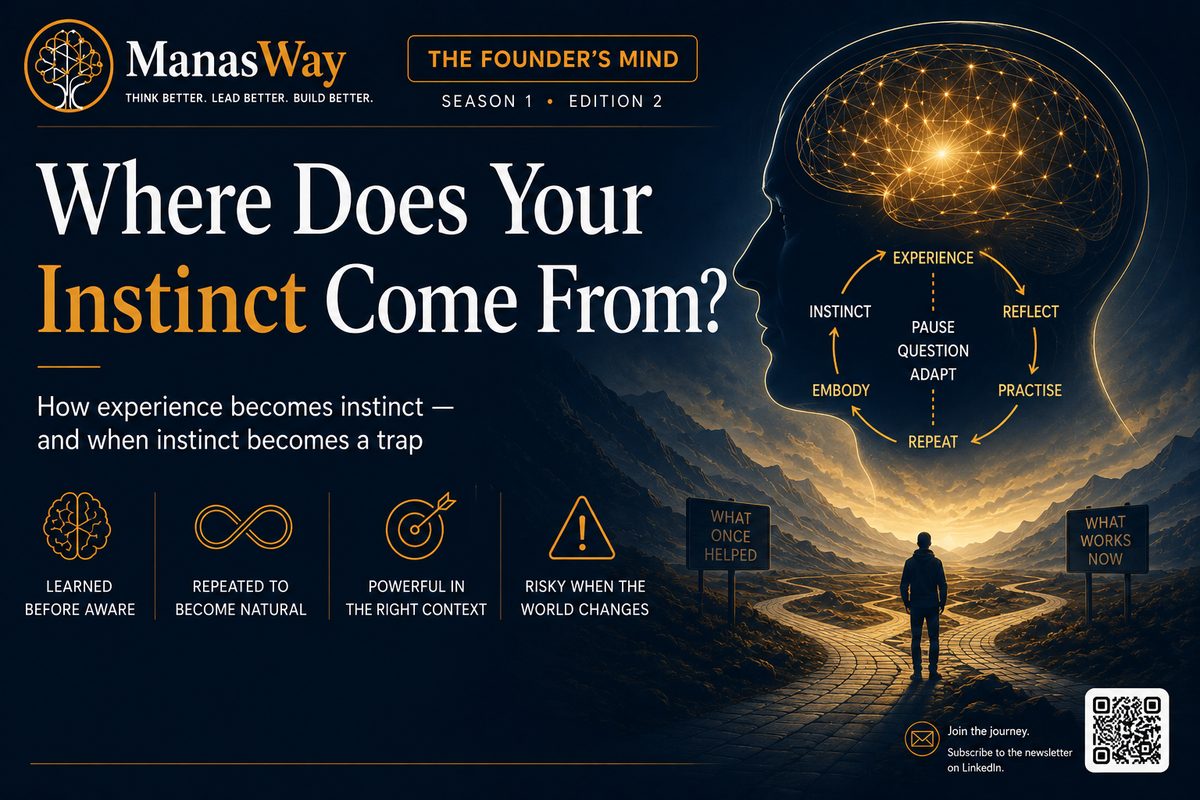
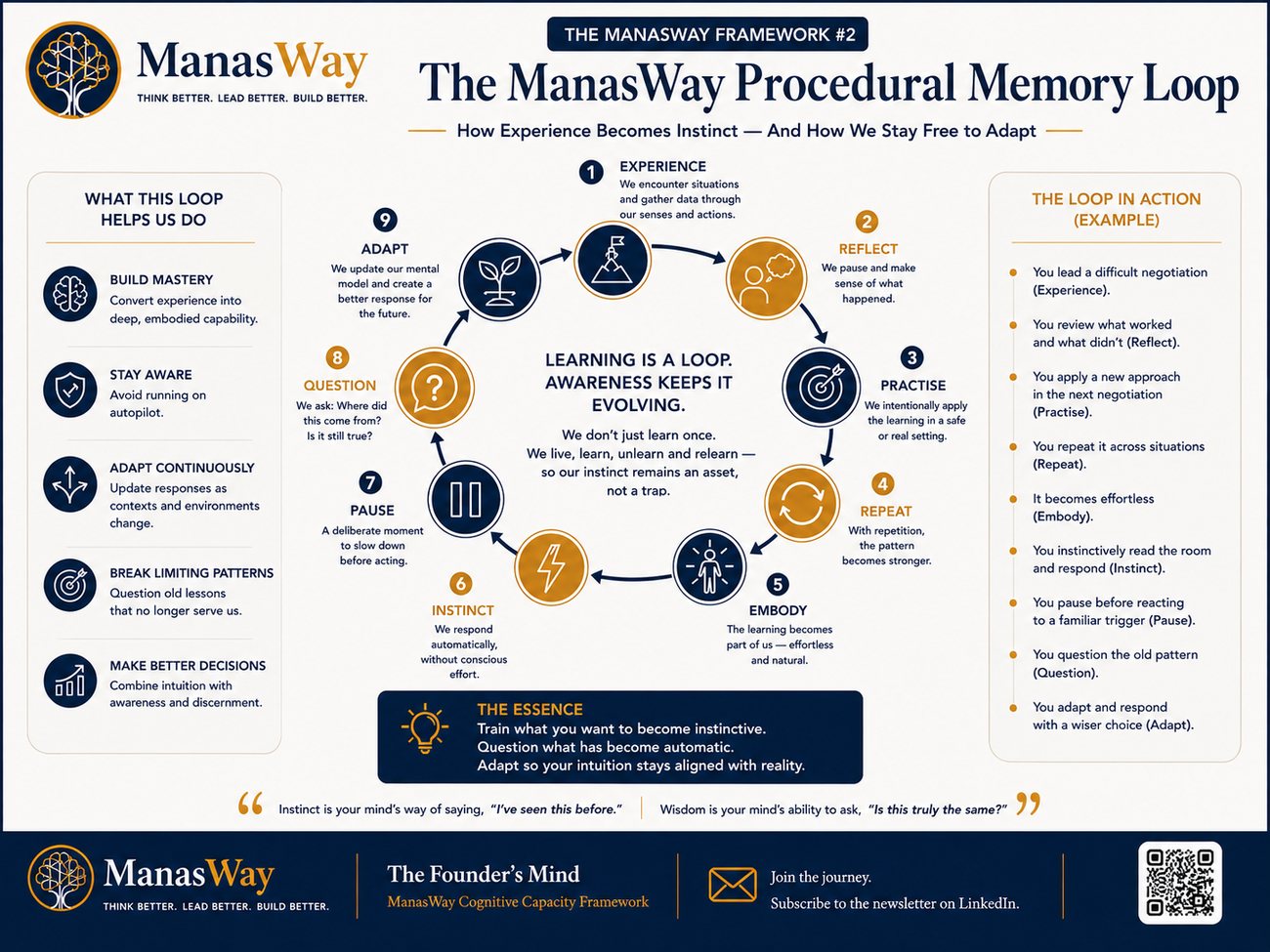
Learning is a loop. We experience. We reflect. We practise. We repeat. The pattern becomes embodied. Eventually, it can become instinctive.
But instinct is not the end of learning. It is where awareness becomes even more important. Pause. Question. Adapt. Because what has become automatic must occasionally be brought back into awareness.
Experience can make us faster. Reflection makes us wiser.
— ManasWay Note
The Founder's Pause
Imagine you are about to make an important decision. You hear yourself thinking: I know how this is going to go. Stop for a moment. Not because your instinct is necessarily wrong. But because it deserves to be examined. Ask:
- What am I noticing?
- What experience is informing this feeling?
- Have I actually seen this before?
- What am I assuming?
- And perhaps the most important question: is this really the same situation?
That pause creates something precious: a small space between pattern and response. And sometimes, that space is where better judgment lives.
Train what you want to become instinctive
This is the opportunity hidden inside procedural learning. If repetition can make behaviour increasingly automatic, then we should become deliberate about what we repeatedly practise. Don't just practise the skill. Practise the quality of response you want to become natural.
- Practise listening before reacting.
- Practise asking before assuming.
- Practise stepping back before deciding.
- Practise recognising patterns without becoming imprisoned by them.
- Practise adapting.
Because what becomes automatic today may become tomorrow's instinct.
But question what has become automatic
This is the other half of the loop. Some of our most deeply embedded behaviours deserve examination precisely because they feel so natural. The reaction you don't question. The assumption you don't notice. The leadership style that has always worked. The decision you make almost immediately. The person you instinctively trust — or distrust. The risk you automatically avoid. The problem you always solve yourself.
These may all be strengths. Or they may be old answers to old questions. Only reflection can begin to tell us which.
A different way to think about instinct
Perhaps instinct isn't something we should simply trust or distrust. Perhaps it is something we should listen to. Instinct can be valuable because it carries information from our accumulated experience. But experience is not the same as truth. It is a record of what we have encountered. And every record has a context.
So when instinct speaks, perhaps the mature response is neither trust your gut nor ignore your gut, but: understand your gut.
The Founder's Question
The next time your instinct speaks, listen. Then ask: where did you learn this?
You might discover experience speaking. You might discover wisdom. You might discover fear. You might discover an old defence. You might discover a pattern that has served you brilliantly. Or you might discover that it no longer serves you at all.
That is the interesting thing about instinct. It is not simply about what you know. It is also about what your history has taught you to notice.
One thought to carry with you
We spend a great deal of time trying to become better thinkers. But some of the most important decisions we make happen before deliberate thinking fully begins. Our experience has already taught us something. Our practice has already shaped something. Our history has already left something behind. And sometimes that learning becomes so familiar that we simply call it: who we are.
So the next time you think I just have a feeling — pause. Don't dismiss it. Don't obey it. Get curious. Because your instinct has a history. And understanding that history may be one of the most important forms of self-awareness a founder can develop.
Train what you want to become instinctive. Question what has become automatic. Adapt when reality changes. And perhaps that is where instinct begins to become something more than a reflex. It begins to become wisdom.
Your experience doesn't just teach you what to do. It teaches you what to notice.
— ManasWay Note
What comes next?
If instinct is shaped by what we have experienced, practised and repeated, another question naturally follows: what happens when the mind has to make a decision with more information than it can consciously process? We move next from instinct to attention. Because before we can decide what to do, something has already decided what deserves our attention.
Coming next in The Founder's Mind: What Gets Your Attention? And what does your mind quietly ignore?
References · Go deeper
The research behind this edition draws from neuroscience and cognitive science on procedural learning, skill acquisition, automaticity, habit formation and the interaction between learned behaviour and goal-directed control.
Procedural memory and skill learning — an overview of procedural memory and the processes involved in skill acquisition (PubMed).
Procedural learning across the lifespan — how procedural learning develops and operates across different stages of life (PubMed).
Habit formation — how behaviour can shift from goal-directed control toward habitual control; the role of the basal ganglia (Nature Reviews Neuroscience).
Goal-directed and habitual control — how these two forms of behavioural control interact (Nature Reviews Neuroscience).
Learning and the prefrontal cortex — timescales of learning in prefrontal cortex (Nature Reviews Neuroscience).
Bruce Lee — his ideas are used here as a philosophical lens on mastery, practice, awareness and adaptability, rather than as scientific evidence for procedural memory.
The question to carry into your week
What is one thing you do instinctively — and where did you learn to do it that way?
Think Better. Lead Better. Build Better.
— Mohanram PV, Creator of The ManasWay

Mohanram PV
Creator of The ManasWay. Nearly three decades in technology, working with startups, CEOs and governments. Writer and poet.