Edition 1 · Working Memory · The Founder's Mind
Working Memory
The invisible advantage every founder should protect
By Mohanram PV · 17 July 2026 · 6 min read
“For one whose mind is unsteady, there is neither wisdom nor meditation; and without meditation there is no peace. Without peace, how can there be happiness?”
— Bhagavad Gita 2.66
“The mind is not a vessel to be filled, but a fire to be kindled.”
— Plutarch
Artificial Intelligence is transforming how we work. Knowledge is becoming abundant. Information is becoming instantaneous. Answers are becoming inexpensive.
Yet one capability is becoming increasingly valuable: the ability to think clearly.
Every breakthrough begins as an idea. Every strategy begins as a question. Every enduring company is built twice — first in the founder's mind, then in the marketplace. That is the journey of The ManasWay.
The invisible workspace of leadership
Every founder has experienced this moment. You're deeply engaged in solving a critical business problem. A notification appears. Your phone rings. An email demands attention. Someone walks into your office. A meeting reminder pops up. Ten minutes later you return to the original problem… and your train of thought has disappeared.
It feels like you've simply lost focus. But something more important has happened. You've lost working memory.
Working memory is the brain's temporary workspace. It enables us to hold information, connect ideas, compare alternatives, evaluate risks, and make decisions in real time.[1] Unlike long-term memory, which stores knowledge accumulated over years, working memory exists only in the present moment.
It is where reasoning happens. It is where strategy is formed. It is where leadership begins. For founders, working memory may be the most valuable cognitive asset they possess.
Ancient wisdom, modern science
One of the ideas behind The ManasWay is that many of the questions explored today by neuroscience and cognitive psychology are not entirely new. Across civilizations — from the Upanishads and the Bhagavad Gita to Buddhist philosophy, Stoicism, Confucian thought, and Greek philosophy — scholars and sages reflected deeply on the nature of the mind, attention, judgment, and human flourishing.
Although these traditions did not describe the brain in scientific terms, they consistently emphasized that the quality of our lives depends on the quality of our minds.[2] Modern neuroscience now helps explain why.
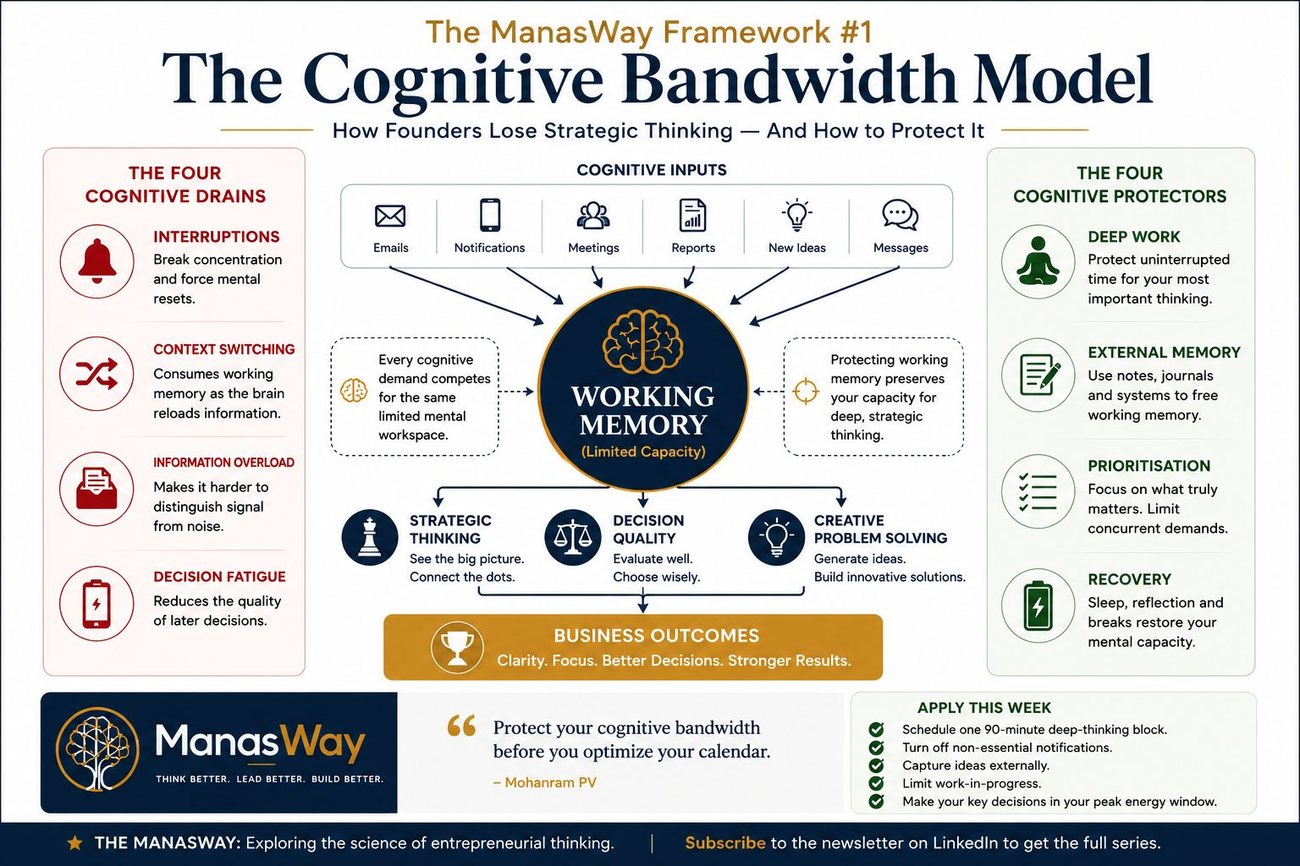
Working memory is a limited cognitive resource. It is where information is temporarily held, alternatives are evaluated, ideas are connected, and decisions are formed. Every distraction competes for that same mental workspace.
Ancient wisdom described the experience. Modern science explains the mechanism. Together they remind us that mastering the mind remains one of leadership's greatest disciplines.
Why working memory matters
Research in cognitive psychology and neuroscience consistently shows that working memory plays a central role in reasoning, learning, creativity, and executive decision-making.[3][4] In environments characterized by uncertainty and complexity, founders with stronger working memory are generally better able to:
- Evaluate multiple alternatives before making important decisions.
- Recognize patterns across seemingly unrelated information.
- Prioritize effectively under uncertainty.
- Resist impulsive reactions.
- Maintain strategic focus despite constant interruptions.
- Connect today's operational decisions with tomorrow's strategic vision.
Working memory is not about remembering more. It is about thinking better.
The hidden cost of cognitive load
Modern work environments are not designed to protect working memory. Notifications. Emails. Meetings. Social media. Context switching. Continuous connectivity. Each competes for the same limited mental workspace.
The result is cognitive load — the total mental effort required to process information. John Sweller's pioneering work on Cognitive Load Theory demonstrated that working memory has limited capacity. As cognitive demands increase, fewer mental resources remain available for deliberate reasoning and strategic thinking.[5]
Every interruption carries an invisible cost. Not because it consumes time. Because it consumes thinking capacity.
“Your competitive advantage is no longer how much information you possess. It is how much complexity your mind can hold without losing clarity.”
— The ManasWay Insight™
Protecting your cognitive advantage
“You have power over your mind — not outside events. Realize this, and you will find strength.”
— Marcus Aurelius
Protecting working memory is not merely a productivity technique. It is a leadership discipline. Simple practices can significantly improve your cognitive bandwidth:
- Schedule uninterrupted deep-thinking sessions.
- Turn off unnecessary notifications.
- Capture ideas in a notebook instead of relying on memory.
- Limit simultaneous strategic priorities.
- Make important decisions during your peak mental-energy hours.
- Build regular recovery periods into your day.
Exceptional founders distinguish themselves not merely by intelligence, but by protecting the conditions required for exceptional thinking.
Why this matters more in the age of AI
Artificial Intelligence is rapidly reducing the value of information as a competitive advantage. But it is simultaneously increasing the value of human judgment.
AI can process information. AI can generate ideas. AI can recognize patterns. But it cannot replace wisdom. It cannot define purpose. It cannot exercise judgment under uncertainty.
As AI becomes increasingly capable, the founders who build enduring companies will not simply be those who know the most. They will be those who think the clearest.[6] Working memory is where that advantage begins.
Protect it. Strengthen it. Your next breakthrough may depend on it.
Reflection
Before you leave today's edition, pause for a moment. Ask yourself:
- What currently consumes most of my cognitive bandwidth?
- Which interruptions repeatedly derail my deepest thinking?
- Am I protecting time for strategic reflection — or merely reacting to constant demands?
- What one change can I make this week to protect my mental workspace?
Coming next month — Attention: why focus is the new competitive advantage
Working memory determines how much information your mind can process. Attention determines what information enters that workspace. In the next edition, we'll explore why attention has become one of the scarcest — and most valuable — resources for founders and leaders in the age of AI.
References & further reading
Ancient wisdom [2] — Bhagavad Gita (Chapters 2, 3 and 6); The Principal Upanishads; Meditations, Marcus Aurelius; Discourses, Epictetus.
[1] Baddeley, A. D., & Hitch, G. (1974). Working Memory. In The Psychology of Learning and Motivation.
[3] Baddeley, A. D. (2003). Working Memory: Looking Back and Looking Forward. Nature Reviews Neuroscience, 4(10), 829–839.
[4] Cowan, N. (2014). Working Memory Underpins Cognitive Development, Learning, and Education. Educational Psychology Review, 26, 197–223.
[5] Sweller, J. (1988). Cognitive Load During Problem Solving: Effects on Learning. Cognitive Science, 12(2), 257–285.
[6] Kahneman, D. (2011). Thinking, Fast and Slow; Goleman, D. (2013). Focus: The Hidden Driver of Excellence; Levitin, D. J. (2014). The Organized Mind.
Editor's note
Thank you for reading the inaugural edition of The ManasWay. My belief is simple: every enduring organization is built upon the quality of its leaders' thinking. As Artificial Intelligence transforms the way we work, the ability to think clearly, decide wisely, and lead with purpose will become an even greater competitive advantage.
Each month, The ManasWay will explore one dimension of entrepreneurial thinking by bringing together insights from neuroscience, cognitive psychology, leadership, systems thinking, philosophy, and Artificial Intelligence — connecting timeless wisdom with modern science to help founders and leaders build better organizations.
If this edition sparked a new idea, challenged an assumption, or encouraged you to think differently, I'd be delighted to hear your reflections. And if you know a founder, CEO, entrepreneur, executive, or aspiring leader who might find value in these conversations, please consider sharing it with them. Together, let's build better minds — and better organizations.
Think Better. Lead Better. Build Better.
— Mohanram PV, Creator of The ManasWay

Mohanram PV
Creator of The ManasWay. Nearly three decades in technology, working with startups, CEOs and governments. Writer and poet.