Edition 4 · Mental Models · The Founder's Mind
What Do You Believe?
And how much of your thinking is actually yours?
By Mohanram PV · 15 October 2026 · 11 min read

First published in The Founder’s Mind, a monthly letter on LinkedIn. Subscribe there to get each edition on the 15th.
“All observation must be for or against some view, if it is to be of any service.”
— Charles Darwin, letter to Henry Fawcett, 18 September 1861
Something happens in your business.
Growth slows.
A key hire resigns.
A competitor cuts price.
A large customer goes quiet.
And almost immediately, your mind does something you did not ask it to do.
It explains.
Not after careful analysis.
Before it.
The explanation is already there, waiting, before you have finished reading.
Growth slowed because the market is soft.
The hire left because they weren’t the right fit.
The competitor cut price because they’re desperate.
The customer went quiet because procurement is slow.
Each of those might be true.
But notice what happened.
You did not gather evidence and then form a view.
You formed a view, and then went looking.
Something in your mind already held a picture — of how this business works, why people leave, what a competitor’s move means.
And that picture supplied the answer before you asked the question.
These pictures have a name.
Mental models.
They are not opinions you hold.
They are the lenses you hold opinions through.
And most of them were never chosen.
They were absorbed.
From a first job.
From a mentor you wanted to impress.
From one early success that seemed to prove something.
From one failure you decided never to repeat.
From an industry that quietly taught you what normal looks like.
So perhaps the question worth sitting with this month isn’t:
“Am I thinking clearly?”
You probably are. Clearly, quickly, and with real conviction.
Clarity was never the problem.
Whose thinking am I repeating?
Your mind builds a model, and then lives inside it
A mental model is not a belief you could recite if asked. It is the structure underneath the belief — your working theory of what causes what.
And the founder’s problem is that it runs whether or not you know it is there.
Kenneth Craik set this out in 1943, in The Nature of Explanation.
The mind, he suggested, builds small-scale models of external reality — and runs them.
We do not respond to the world directly.
We build a working replica of it inside the head, test possible actions against the replica, and act on the result.
This is why you can decide not to send an email before sending it.
You ran the model.
Craik explained that the mind runs a model. He did not explain where the model comes from.
Forty years later, Dedre Gentner did. Her structure-mapping theory described how we build an understanding of something unfamiliar: we borrow the structure of something we already understand.
We’re running out of runway. The pipeline has dried up. We need a deeper moat.
Three metaphors, and not one of them is heard as a metaphor any more. That is precisely when they do their work.
A runway says there is one direction and a point past which you cannot stop. A pipeline says customers flow, and the fix is to pour more in at the top. A moat says the thing to protect is what you already hold.
What transfers is never the surface detail. It is the relational structure — what acts on what, and what follows from what.
So a borrowed metaphor is a borrowed causal theory.
If your company is an engine, you look for the part that is dragging.
If it is a garden, you look at the conditions.
Same company.
Different problems become visible. Different solutions become thinkable.
And you chose that metaphor years ago, almost certainly without noticing you were choosing anything.
When a good answer blocks a better one
Expertise is largely a matter of having richer models. A chess master does not calculate more moves than a weaker player. They see the board in patterns, and the patterns get them to a good move faster.
The model does the work.
What happens when the model that makes you fast is also the model that stops you looking?
In 2008, Merim Bilalić, Peter McLeod and Fernand Gobet published a study in Cognition that answers it with unusual clarity.
They gave strong chess players a position containing two solutions: a familiar one they would recognise immediately, and a better one, hidden.
When the familiar solution was available, not one of the expert players found the better move.
When the same players were given a position where the familiar solution had been removed, every one of them found it.
The timing is the sharpest part. Players took about 37 seconds to settle on the familiar solution. Finding the optimal move, once the familiar one was unavailable, took around 148 seconds.
The players reported that they were searching for a better solution.
The eye-tracking showed they were not.
Their gaze kept returning to the squares belonging to the first idea.
They believed they were considering alternatives.
They were re-examining the same one.
Psychologists call this the Einstellung effect — from Abraham Luchins’ work in the 1940s. A good idea that arrives early blocks a better one that would have arrived later.
Not by argument.
By occupying the space where the better idea would have formed.
A good friend and former boss of mine, Jagdish Patankar, used to put it in one line.
Let better not be the enemy of the best.
It inverts the proverb everyone knows. The usual warning is that perfect stops you shipping good. His was the opposite — and for an experienced founder it is the more dangerous one. The good answer you already have is what stops you finding the better one.
Indian philosophy named this long before anyone measured it.
The Bhagavad Gita describes a kind of knowledge that clings to one single effect as if it were the whole — without inquiry, without foundation in truth, and narrow (18.22).
Not ignorance. Something more confident than that.
One explanation, held as if it were the entire picture.
It is not an account of a mechanism. It is a different lens on the same thing.
The faculty that gives you clear sight and the faculty that gives you confident error are not two different faculties.
Every company runs on a theory it stopped questioning
Every company runs on a theory.
Peter Drucker called it the theory of the business — the set of assumptions a company holds about its environment, its mission, and the competences it needs to accomplish that mission.
Writing in 1994, his observation was blunt.
Most organisations in trouble are not badly run.
They are running correctly — on a theory that has stopped being true.
The assumptions were right once.
The market moved.
The assumptions stayed.
Drucker’s description of what happens next is the line worth keeping.
The organisation remembers the answers, but has forgotten the questions.
It still knows what it does. It has stopped knowing why that was ever the right thing to do.
And a company executing well against an expired theory does not slow down. It travels faster in the wrong direction. Drucker’s example was General Motors, which put energy, hard work and money into patching — including some $30 billion spent automating mass production — while the growth market it actually needed went neglected.
The effort was real.
The theory underneath it was not.
Your model found you a good move early.
It worked.
It kept working.
And now it arrives so quickly that you no longer experience it as a choice.
What a founder’s model usually contains
Most founder models are not about markets. They are about causation — what reliably produces what.
- How growth happens here. Sales effort, or product quality, or distribution, or price.
- Why people leave. Compensation, or manager, or ambition, or fit.
- What a competitor’s move means. Strength, or desperation, or noise.
- What good looks like in a team. Speed, or rigour, or harmony, or challenge.
- Where risk lives. In spending, or in not spending.
You hold a position on every one of these.
You probably could not say when you decided any of them.
Here is a test you can run on that list right now.
Read it again and notice which answer arrived instantly.
That one is the model.
The items you had to think about are still live questions in your mind. The one that answered itself before you finished reading has stopped being a question at all — and that is exactly the condition under which a model stops being examined.
The decision Intel could not make
Intel was a memory company. Memory chips were the business it was founded on, the business its identity rested on, the business its engineers were proud of. By the mid-1980s Japanese manufacturers were taking the market on cost and quality, and Intel was losing badly.
Intel had debated it for a long time without resolving it. Then, as Andy Grove tells it in Only the Paranoid Survive, he asked Gordon Moore a question.
If the board threw us out and brought in a new CEO, what would that person do?
Moore answered without hesitating: get out of memory.
Why don’t we walk out the door, come back in, and do it ourselves?
The question supplied no new information. They already had every fact.
It removed a model.
A new CEO would arrive without Intel’s history, without the pride, without the memory of what memory chips had meant. Same data. No inherited lens.
And the answer became obvious the moment the lens came off.
Seeing it was not the same as doing it. The exit from memory took Intel until 1987 to complete, and it was painful. But the decision had stopped being unclear.
Most hard founder decisions are not blocked by missing information.
They are blocked by a model that makes the information mean something else.
The ManasWay Model Audit™
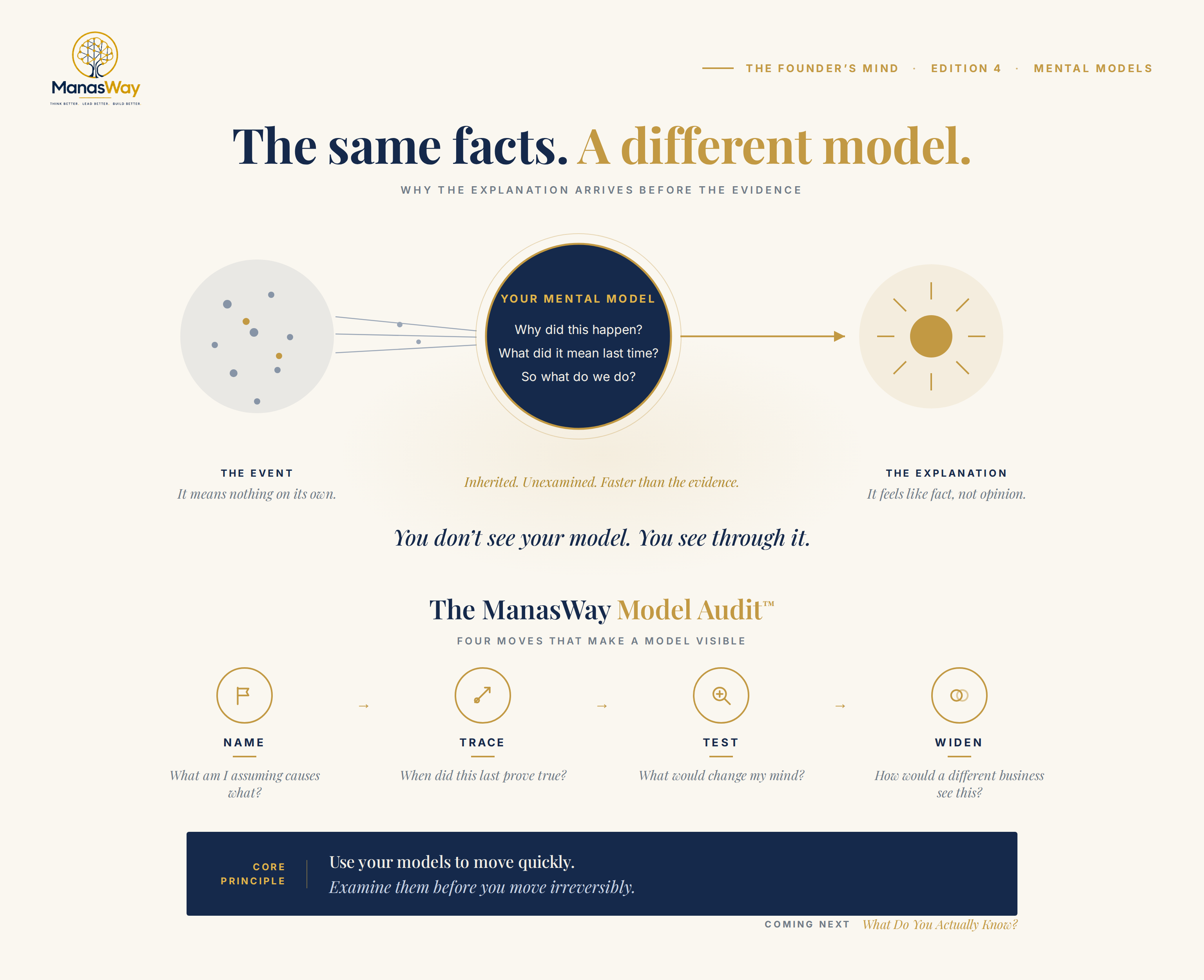
You cannot remove your models. You would not want to — without them you would reason every situation from nothing, and be slow in exactly the moments where speed matters.
The work is making one visible long enough to ask whether it still fits.
Four moves do it. Here they are on the most ordinary problem a founder has.
The event. Signups are down 18% on last quarter.
Before anyone opens a dashboard, your mind has produced a complete account. The market is soft. Last time growth dipped, you pushed outbound and it recovered. So: two sales hires, more outbound.
That took four seconds, and it did not feel like a guess. It felt like judgement.
NAME — what am I assuming causes what?
“Growth comes from sales effort. More outbound, more pipeline, more growth.”
Most founders hesitate here, and the hesitation is the finding. A belief you can state instantly and completely is one you have stopped checking.
TRACE — when did this last prove true?
“2019. A few hundred thousand in revenue, growth stalled, we hired two salespeople, and we doubled.”
Last, not first. First invites a founding story. Last forces a date — and the date does the work. Smaller company, different buyer, founder-led selling, almost no competition. The model was built inside a company that no longer exists.
TEST — what would change my mind?
“If outbound were already up while conversion had fallen, effort is not the problem.”
Then the half almost nobody runs: have I actually looked? Usually you looked at pipeline totals, not conversion by stage. You were searching — sincerely — on the same screen as always.
WIDEN — how would a different business see this?
A subscription business reads a signup dip as retention surfacing at the top of the funnel. A manufacturer reads it as demand shifting segment. A retailer reads it as shelf position — you are no longer where the customer looks first.
Any could be true. None is reachable from inside a model that says growth comes from effort.
The original decision was to hire two salespeople. The audit makes the real question whether conversion fell, whether churn is rising underneath, and whether the product drifted upmarket while the sales motion stayed put.
That is a materially different quarter — and no new information arrived.
The audit did not add anything. It removed a model, and the facts started meaning something else.
Use your models to move quickly. Examine them before you move irreversibly.
Core principle
Once a quarter, write on one page what your company’s success depends on being true, and date it. Compare it with last quarter’s. The drift is the insight.
The Founder’s Pause
Bring to mind a decision you are close to making.
Not a small one.
One that will be hard to reverse.
Then catch the model while it is still working:
What did I decide this meant, before I had the facts?
Which explanation came out whole, without effort?
Which one would I defend hardest if challenged?
And the one worth carrying furthest:
Which of my beliefs about this business have I never once tested — because they have always worked?
A good model will find you a good answer quickly. That is what makes it hard to notice the better one it is standing in front of.
— ManasWay Note
Can AI show you your own model?
Most of us use it the same way. You describe the situation, you ask what to do, and it comes back fast and reasonable.
And more often than not, it agrees with you.
That feels like confirmation.
It is usually something else.
Look at how you asked. Our churn is rising. How do we improve retention?
It answered your question.
It did not question your question.
So the more useful move is to stop asking for the answer and start asking for the frame.
What am I assuming just by asking it this way?
Make the strongest case that my premise is wrong.
Describe my situation the way a hospital administrator would. Then a restaurant owner.
That last one runs the audit’s fourth move for you — Gentner’s structure-mapping, used deliberately instead of by accident.
You cannot audit a model from inside it.
But there is a caution, and it is not the usual one about accuracy.
These systems are built from an enormous amount of human writing. That makes them superb at producing the consensus view of any domain — which is to say, the model most people in your market are already running.
Ask it for the standard answer and you will get the standard answer, delivered with real fluency — the same one your competitors are being handed this week.
Ask it what you are not seeing, and it becomes something closer to a sparring partner.
And there is one thing it cannot do.
It does not know which of your models you are emotionally invested in.
It cannot tell which assumption came from a mentor whose approval still matters to you. Which belief is holding up your sense of yourself as a founder. Which one you would keep defending long after the evidence had turned.
You know.
Or you could. That part stays yours.
Coming next
What Do You Actually Know?
When the inherited models are stripped away, what is left standing?
This edition argued that most of our thinking runs on models we inherited. The natural next question is what remains when you strip them away — and whether it is possible to reason from what is true rather than from what is assumed.
That is first principles thinking, and it is Edition 5.
Go deeper
Kenneth Craik, The Nature of Explanation (Cambridge University Press, 1943). The origin of the idea that the mind runs small-scale models of reality.
Philip Johnson-Laird, Mental Models: Towards a Cognitive Science of Language, Inference and Consciousness (Harvard University Press, 1983). Reasoning as model construction rather than logic.
Dedre Gentner, “Structure-Mapping: A Theoretical Framework for Analogy”, Cognitive Science 7 (1983), 155–170. How a model transfers from one domain to another.
Merim Bilalić, Peter McLeod and Fernand Gobet, “Why good thoughts block better ones: the mechanism of the pernicious Einstellung (set) effect”, Cognition (2008). The chess study, including the eye-tracking evidence.
Abraham Luchins (1942). The original Einstellung experiments on mechanisation in problem solving.
Adriaan de Groot, Thought and Choice in Chess (1946/1965); William Chase and Herbert Simon, “Perception in Chess”, Cognitive Psychology (1973). Expertise as pattern recognition rather than deeper search.
Peter Drucker, “The Theory of the Business”, Harvard Business Review, September–October 1994.
Andrew S. Grove, Only the Paranoid Survive (1996). The Intel memory decision and the new-CEO question.
Charlie Munger, “A Lesson on Elementary, Worldly Wisdom” (USC Business School, 1994). The latticework of mental models.
Philip Tetlock, Expert Political Judgment: How Good Is It? How Can We Know? (Princeton University Press, 2005). Foxes, hedgehogs and the cost of a single grand model.
Think Better. Lead Better. Build Better.
— Mohanram PV, Creator of The ManasWay

Mohanram PV
Creator of The ManasWay. Nearly three decades in technology, working with startups, CEOs and governments. Writer and poet.
← Previous edition
What Gets Your Attention?
Next edition →
What Do You Actually Know? Coming 15 November