
Edition 3 · Cognitive Bias · The Founder's Mind
What Gets Your Attention?
And what does your mind quietly ignore?
By Mohanram PV · 15 September 2026 · 5 min read
There is more happening around us than we ever notice. A customer hesitates. A competitor changes direction. A team member stops challenging an idea. A new technology quietly becomes useful. A number in the dashboard moves. A conversation keeps getting postponed. A problem appears small, until it isn't.
The world keeps sending signals. We don't receive all of them. And that raises a more interesting question than “How do I pay more attention?”
What determines what gets my attention in the first place?
“My experience is what I agree to attend to”
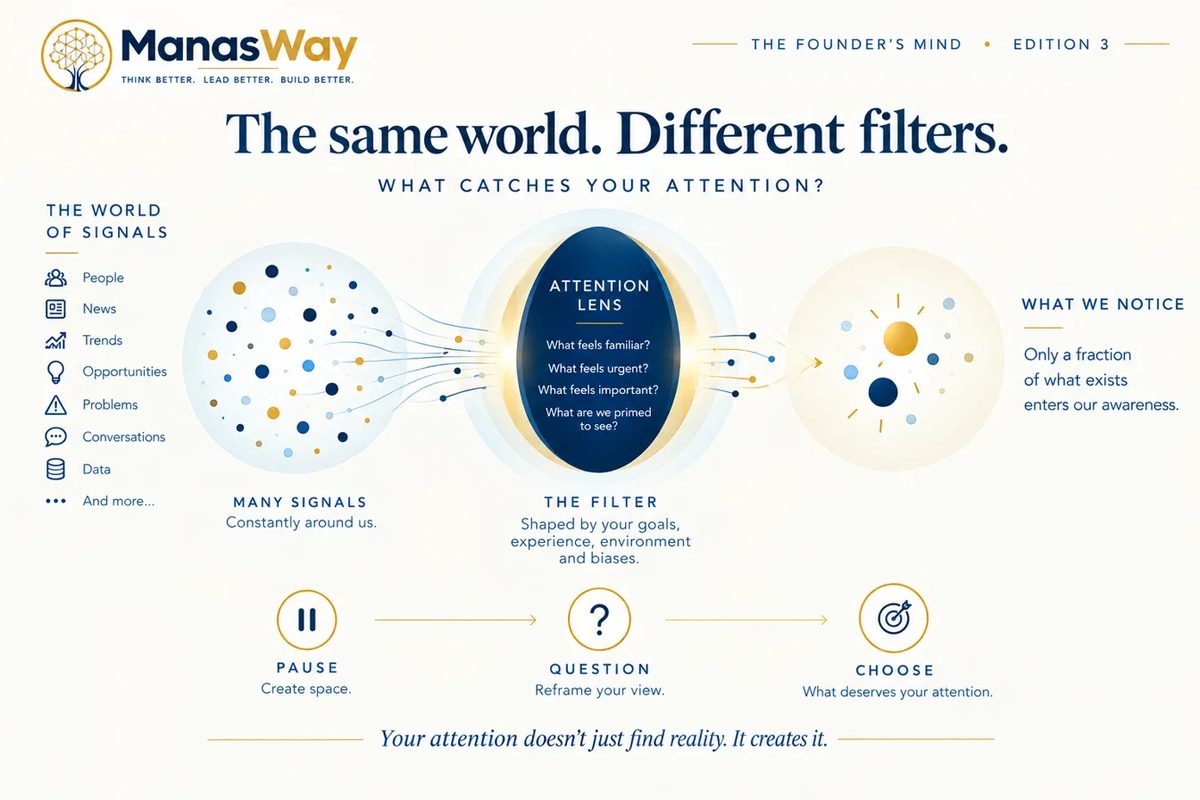
William James wrote those words in The Principles of Psychology. For James, attention was not simply about looking harder. It was about selection. Of the countless things available to us, some enter the foreground of experience while others remain outside it.
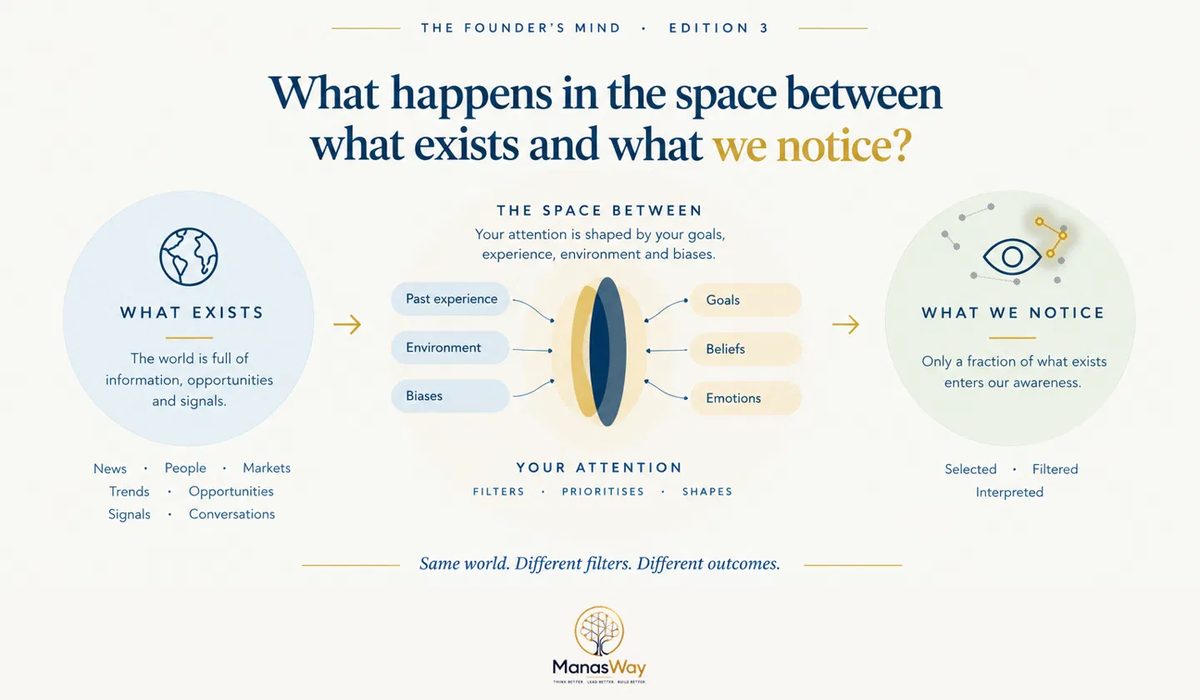
More than a century later, neuroscience and cognitive psychology are giving us a more detailed picture of that selection. Our attention is influenced by what we are trying to achieve, what stands out around us, and what our previous experience has taught us to notice.
Which means something important: your attention has a history.
The things you have succeeded at can teach you where to look. The things that have hurt you can teach you what to avoid. The things that have repeatedly demanded your attention can begin to feel important simply because they are familiar. And the things you have learned to ignore may become harder to see.
Consider Nokia
At its height, Nokia was not a company that lacked intelligence, resources or market knowledge. In 2008, it was the world's largest mobile-phone manufacturer, with roughly 40% market share. But the basis of competition was changing. The industry was moving beyond the handset itself toward software, operating systems, platforms and ecosystems. Nokia was facing that shift while also managing enormous pressure to deliver against the business that had made it successful.
An INSEAD case study describes part of what followed as “temporal myopia” — an excessive focus on short-term innovation at the expense of longer-term opportunities. It also describes an organisational environment where fear made people reluctant to share negative information upward, leaving senior leaders with an overly optimistic picture of reality.
That makes the Nokia story interesting for us. Not because Nokia failed to see anything. But because a successful organisation can become extremely good at paying attention to what it already knows matters. And that can make something else harder to see.
This is where the story becomes personal
A founder's attention is rarely neutral.
- Look at your calendar. What repeatedly earns your time?
- Look at your conversations. Which problems get discussed immediately?
- Look at your metrics. Which numbers trigger action?
- Look at your team. What kinds of information reach you quickly, and what kinds take courage to bring?
Over time, an organisation learns from the founder's attention. If something consistently gets your response, people learn that it matters. If something repeatedly gets postponed, people learn that too. Your attention doesn't just shape your experience. It can shape the environment around you.
And this is where our previous edition on instinct connects. Your instincts may influence what you notice. But what you repeatedly notice can also reinforce your instincts. The loop becomes difficult to see from inside.
An older lens
Indian philosophical traditions explored a related question long before modern cognitive science. In the Bhagavad Gita, verses 2.62–63 describe a progression that begins with repeatedly dwelling upon something, followed by attachment, desire and eventually a disturbance of judgment.
It isn't a neuroscience explanation. It is a different lens. The insight is about what repeated mental dwelling can do to us: what occupies the mind can begin to shape the mind. And perhaps that is worth considering as leaders. Because attention is not only about what we see. It is also about what we keep returning to.
The more uncomfortable question
The question, then, isn't “Am I paying attention?” You almost certainly are. The more uncomfortable question is:
What has my experience taught me to notice, and what might it have taught me to overlook?
That question changes the conversation.
Maybe your experience has made you exceptionally good at spotting cash-flow problems, but slower to notice cultural problems. Maybe you immediately notice customer complaints, but overlook customer behaviour that hasn't become a complaint yet. Maybe you are excellent at identifying operational risk, but less comfortable noticing an opportunity that has no obvious business case. Maybe you have built a successful company by trusting your instincts — and now those same instincts are quietly deciding what deserves to enter your field of attention.
This isn't about distrusting your experience. It is about knowing that experience has a point of view.
The Founder's Pause
Before the week moves on, pause for a moment:
- What consumed my attention this week?
- What deserved more of my attention?
- And perhaps the most important one: what might become important before it becomes urgent?
The ManasWay Perspective
You cannot notice everything. You cannot process every signal. You cannot remove every filter. But you can become more curious about the filters you have acquired.
Because sometimes the most important signal isn't the one demanding your attention. It is the one you have become so accustomed to overlooking that you no longer recognise it as a signal.
Your attention shapes the field from which your decisions emerge. Choose that field carefully.
— ManasWay Note
Coming next
What Do You Believe? And how much of your thinking is actually yours?
Go deeper
William James, The Principles of Psychology, Chapter XI — Attention.
Jan Theeuwes, “Attentional Capture and Control”, Annual Review of Psychology (2025).
Huy, Vuori & Duke, “Nokia: The Inside Story of the Rise and Fall of a Technology Giant”, INSEAD.
Bhagavad Gita, Chapter 2, verses 62–63.
Think Better. Lead Better. Build Better.
— Mohanram PV, Creator of The ManasWay

Mohanram PV
Creator of The ManasWay. Nearly three decades in technology, working with startups, CEOs and governments. Writer and poet.