
Write · Stories
Café Serendipity
A journey of rediscovery: a solo drive, a roadside café, and a face Manu has not seen in twenty years.
By Mohanram PV · 11 min read
Foreword
Some stories are loud. This one is quiet.
I wrote it during a time when I was thinking deeply about the people and moments that have shaped my life. We all have friends we have lost touch with, words we never said, and choices that changed our paths. This story brings those feelings to life through Manu and Priya.
It reminds us that life does not always go as planned. But sometimes a small detour, a stop at a café, can bring back something meaningful. It might even help us move forward with peace and clarity.
Thank you for reading. I hope it makes you smile, reflect, and perhaps reach out to someone you have been thinking about.
Warm regards,
Mohanram PV
Bengaluru, August 2023
Chapter OneThe Road and the Café
The sun was low by the time Manu left Visakhapatnam behind. He had given himself the weekend and no plan beyond Arka Valley: four hours of hill road and a room he had booked without looking at the pictures. The window was down. Kenny Rogers was on the stereo, with Lionel Richie queued up behind him, the way it had been on every long drive of his life. The engine settled into the long note it kept for open roads, and for the first time in months there was nothing he had to think about.
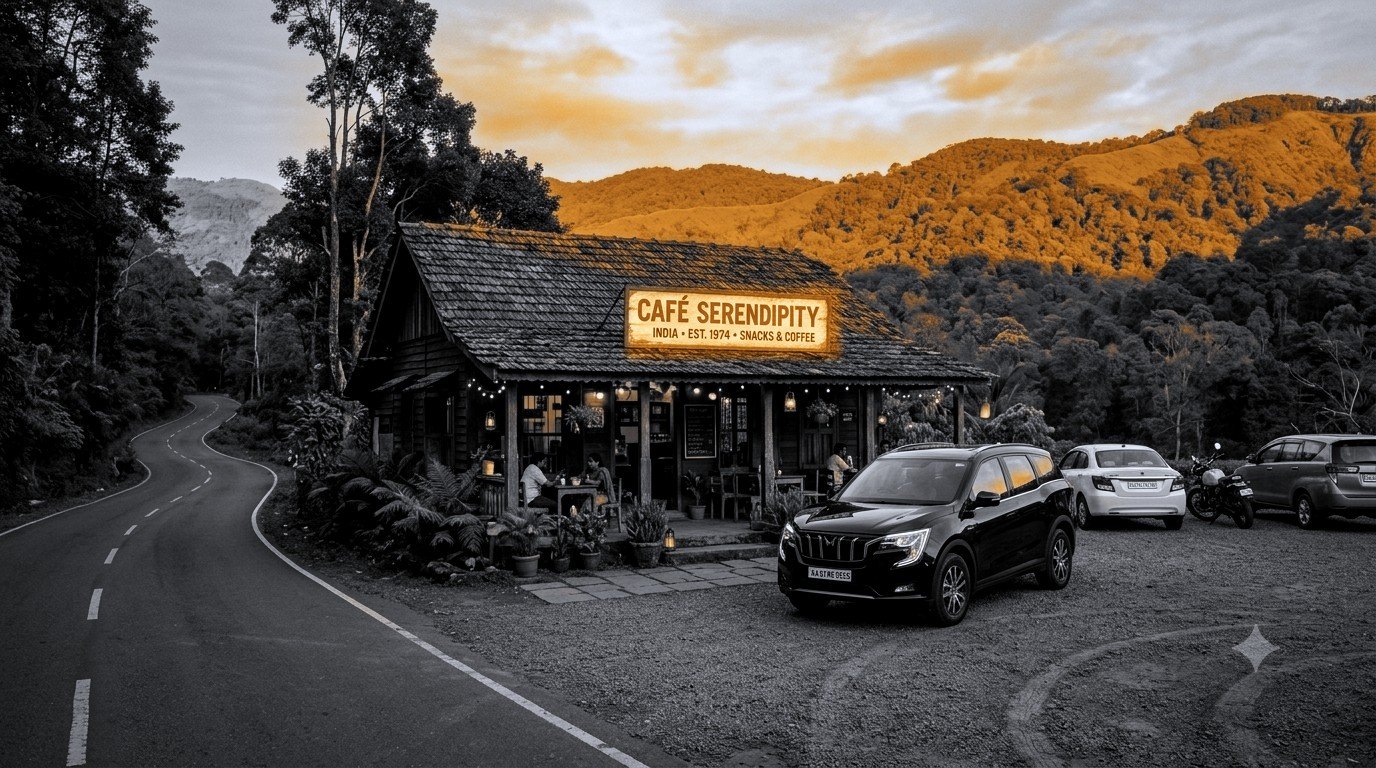
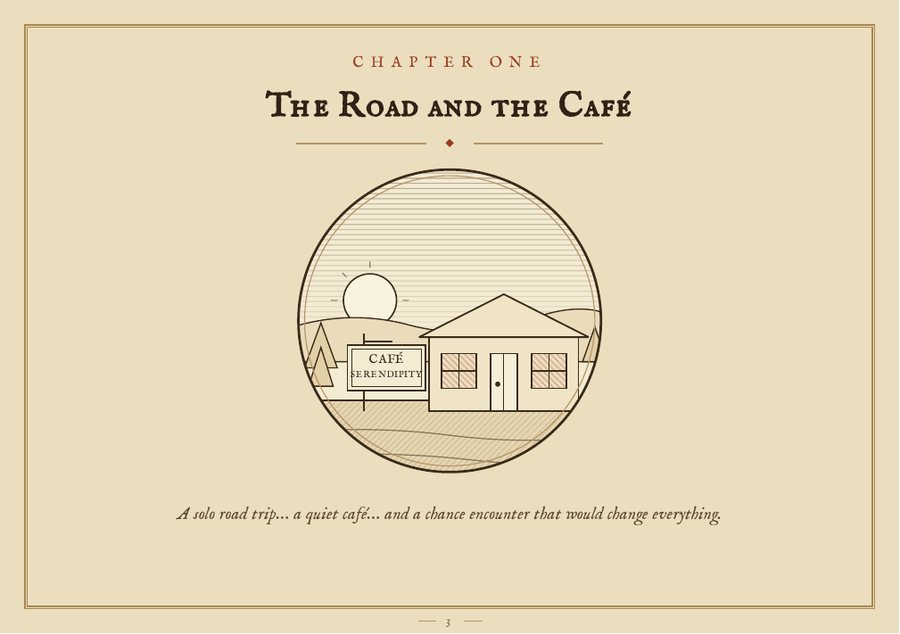
So he thought about nothing, and then about everything, the way one does on a road with more bends than traffic. Somewhere past the third ghat a signboard swung into view on a curve: Café Serendipity: A Haven of Scrumptious Snacks and Refreshing Coffee. The lettering was hand-painted and slightly too ambitious for the building behind it. He liked it at once.
The smell of coffee reached the car before he had switched off the engine. The café was a low wooden place with a tin roof and a veranda, older than anything around it, the kind of building that had watched a great many people stop and go on. Inside, the tables had been wiped so many times the grain stood up under the varnish. Cups clinked against saucers. Manu ordered a black coffee and a plate of cookies, took them to a corner by the window, and for a while did nothing but drink and watch the light go orange on the hills. When he glanced back across the room there were two families arguing gently over a route and, at the far end, one woman on her own, sipping her coffee.
He noticed her the way one notices a change in the weather: gradually, and then all at once.
She sat in the far corner with her back half to the room, in the last of the sun, still and composed in a way the room was not. He could not have said what made him look twice. There was a pull: subtle, steady, and hard to argue with. Then he saw the scar above her right eyebrow. Familiar. Unmistakable. A childhood imprint, the kind time may soften but never quite erases.
A mask covered the rest of her face, a habit left over from the pandemic, but he was certain. He crossed the room before he could think better of it. “Excuse me,” he said. “Have we met before?” She looked up. Her eyes did the widening that the mask could not hide. “Manu?” she said. “Is it really you?”
Priya. The name arrived with everything attached: the lane behind the 8th Cross temple in Malleswaram, Bangalore; the bicycles; the hideout under the water tank that the whole street had known about; the sound of her laugh coming over a wall before she did. He had not seen her in twenty years. He had thought about her more often than that.
Chapter TwoWhat Was Left Unsaid
Twenty years had done what twenty years do to a face. There were lines at the corners of Priya's eyes now, and the mask hid the rest, but the eyes themselves had not changed: they still went bright at the edges when she was about to laugh. She had become a Tribal Vocational Rehabilitation Counselor, she told him, working in villages three hours from anywhere, teaching people to build a living out of what their hands already knew. She said it lightly. Manu, who had spent the same years in glass buildings, understood that it had not been light.
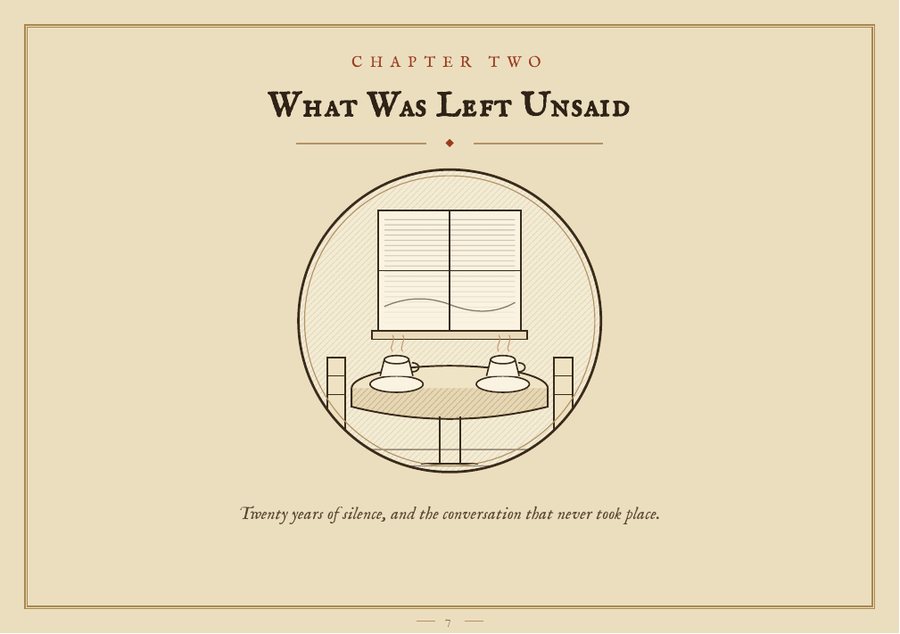
It came to Manu that the last time it had been just the two of them was also over coffee. The evening his final exams ended, the whole gang had wanted to go out and celebrate; he had wanted, more than anything, to sit somewhere quiet with a cup in his hands, and only Priya had peeled away from the others to join him at the Café Coffee Day near the college. They had talked until the staff began stacking the chairs. A fortnight later came the trek, and after that, nothing. Two cafés, twenty years apart, and no one at the table in between.
They talked around the thing for a while, the way old friends do. Then Priya set her cup down.
“Can I ask you something I've wanted to ask for twenty years?”
“You're going to anyway.”
“The trek. Why did you just not come?”
He had known it was coming from the moment he recognised the scar. Six of them had planned that trek for months. On the morning they were to leave, with the bags already in the car, his phone had rung: an interview, his first, for a job he had applied to without much hope. They could see him at noon or not at all. He had stood in the road with the phone in his hand and the engine running, and he had chosen the interview. He sent one message to the group, something came up, go without me, and then, because he could not think how to explain the rest, he sent nothing more.
“We waited an hour,” Priya said. “Then we went. Nobody talked much on the way up.” She turned her cup on its saucer. “I thought you'd decided we weren't worth a day. I didn't hear about the interview until months later, and by then I'd already made up my mind about what kind of person you were. An NGO in the north offered me work that autumn. I took it and left. It was easier to leave than to ask.”
“I got the job,” Manu said. “They wanted me in Pune the next morning. I packed that night and was on the road before any of you were back from the hills. I meant to call you from there and tell you everything. I picked up the phone twice. I didn't know how to start, so I told myself I'd do it tomorrow.” He shook his head. “Twenty years of tomorrow.”
They sat with that. It was not, either of them could see now, a large thing: a call not made, a message not sent, a story told one way for want of anyone to tell it the other. But small things left alone do not stay small. Each had built a version of the other out of one bad morning and carried it, unquestioned, into a whole different life: his in Pune, hers in villages the maps barely bothered with.
“You know the stupid part?” Priya said at last. “That job is the reason you have a car to drive to Arka Valley in. And this café is on the road to Arka Valley. So in a way the interview brought you here.”
Manu laughed, properly, for the first time that evening. “So I owe twenty years of silence to the same phone call that ended it.”
“Life's like that,” she said. “You'd think it would plan better.”
Chapter ThreeMemory, Mischief and Moving On
Later, another memory stirred in Priya's mind: one from their school days, both amusing and a little tender. “You know, Manu,” she said, a playful glint in her eye, “I can't help but recall how you were called ‘granny's pet’ by our group of friends back then.” Manu burst into laughter, the memory rushing back like a gust of wind. “Oh, don't remind me of that!” he exclaimed, a mixture of embarrassment and amusement on his face. “I can't believe they still remember that nickname.” Priya chuckled, her eyes sparkling with mischief. “Well, it's all in good fun. And who would've thought that the ‘granny's pet’ would turn into this adventurous soul driving across the country?”
Their laughter filled the café, and a couple at the next table looked over and smiled. Something in the room had loosened. They talked more easily now, about work, about parents, about the small absurdities of being in one's forties, and it felt less like catching up than like resuming.
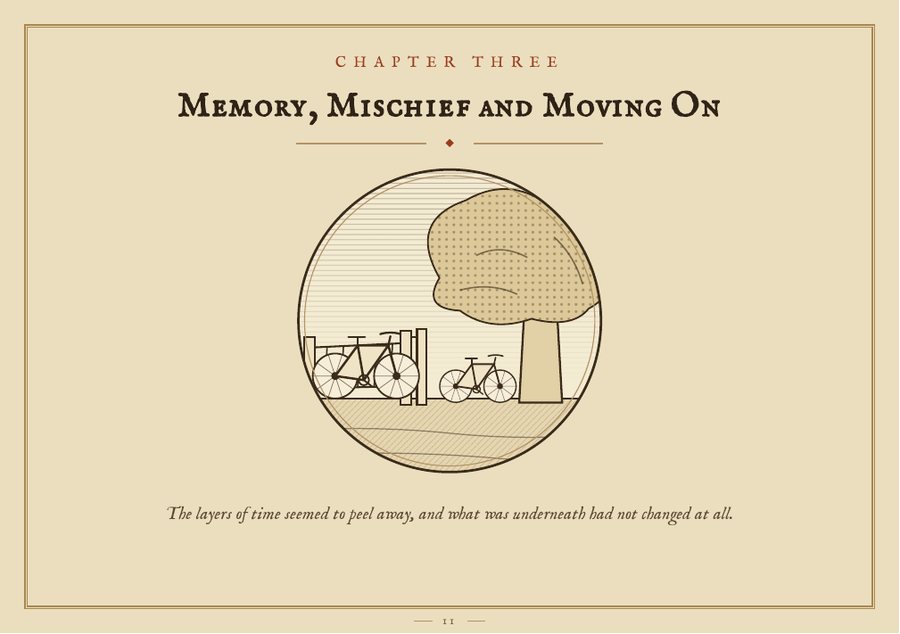
Their talk drifted further back, to the years before the trek, when caring had needed no words at all. Priya touched the scar above her eyebrow without thinking, and Manu remembered the afternoon it happened: a bicycle race down 8th Cross, her front wheel catching a stone, and the long walk home with his handkerchief pressed to her forehead while she insisted, through tears, that she had been winning. It was his grandmother who cleaned the cut and scolded them both in the same breath. From then on Priya had turned up at that gate most evenings, ostensibly for the old lady's sweets, in truth to make sure Manu never walked home alone after dark. He, in turn, had learned which of her silences meant trouble at home, and had simply stayed nearby until they passed. Neither of them had ever called it looking after each other. It was only what they did.
The light had gone from the hills by the time either of them looked at the window. Priya turned her cup one last time. “You know what I keep thinking?” she said. “If you'd come on that trek, we'd have had one more good day and then lost touch anyway. Instead we lost twenty years and got this.” She tipped her head at the table, the cold cups, him. “I'm not sure I'd trade.”
“No,” Manu said, after a moment. “Neither am I.”
When at last they rose to leave, they walked towards the door slowly, neither quite ready to reach it. At the threshold Priya stopped, turned, and opened her arms. Manu had not expected it. For a heartbeat he stood still; then his arms came up around her and he held her, one hand resting lightly on her head the way it had when they were children. He felt the warmth of her tears through his linen shirt before he understood what it was. Neither of them spoke. There were no words for it, and neither of them tried to find any. They stood like that while the café carried on quietly around them, and when they finally stepped apart it was without embarrassment, the way old friends do. Then they walked out through the doorway together, into the last of the evening light.
They said their goodbyes in the car park, promising, and this time meaning it, to stay in touch. With a last wave to her, Manu got into the car and sat for a while without starting the engine. He took a long breath. He could not have named what he was feeling; gratitude was part of it, but not all of it.
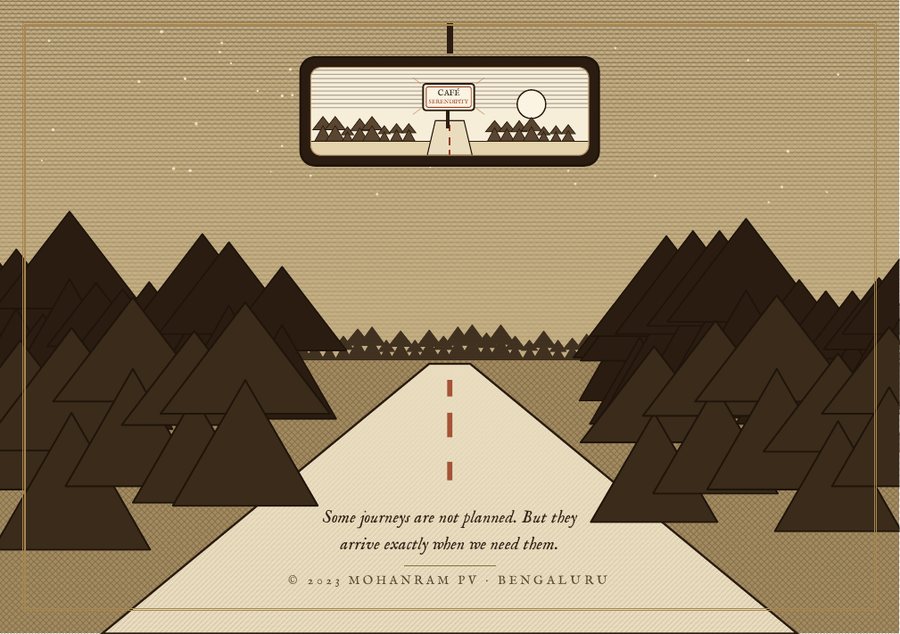
Then he turned the key and pulled out onto the highway, and a little way along, almost without deciding to, he glanced in the rear-view mirror. The signboard was still there, small and lit against the dusk: Café Serendipity. He smiled. There could not have been a truer name for the place. What had been a pit stop on the way to somewhere else had become the point of the journey: an ordinary drive turned into a story of rekindled friendship and unexpected understanding, and a heart that, for the first time in years, felt full. Ahead, the road went on into the dark. He drove towards it, in no hurry now.
Sometimes, the most unexpected turns in life bring us back to the people and the pieces we did not know were missing.
A familiar face. A forgotten scar. A silence that needed no more words.
If this story stirred a memory, a smile, or a desire to reach out — let that be your serendipity. Some journeys are not planned. But they arrive exactly when we need them.
© 2023 Mohanram PV · Bengaluru · All rights reserved

Mohanram PV
Creator of The ManasWay. Nearly three decades in technology, working with startups, CEOs and governments. Writer and poet.
← Previous story
This is the first
Next story →
Journey That Never Happened